How it works
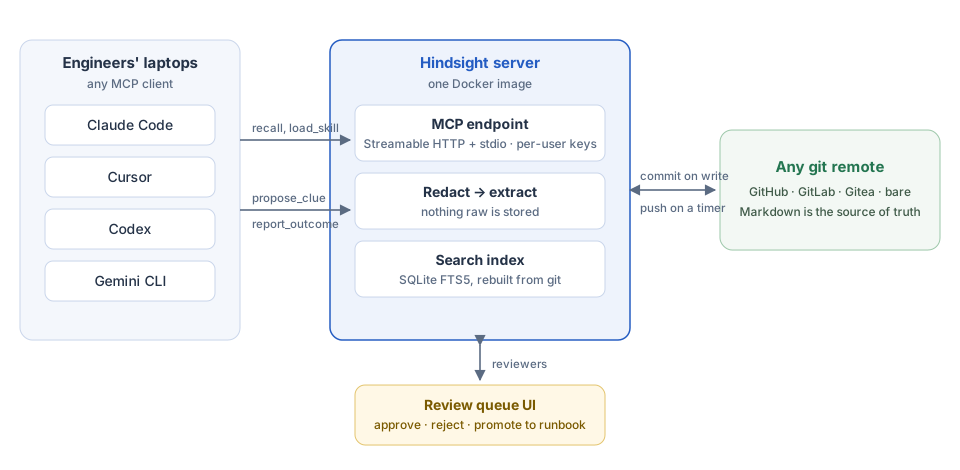
Hindsight owns three things: the team's SRE knowledge, the pipeline that captures that knowledge from agent sessions, and the review gate that turns a messy clue into a trusted fact. It deliberately owns nothing else. There is no agent runtime, no production access and no hosted service.
The knowledge model
Knowledge is typed SRE objects, not free-form notes. Each object is a Markdown file with YAML frontmatter in a git repository, and everything cross-links by service and alert name.
| Object | Path | Holds |
|---|---|---|
| Service | services/<name>.md |
Owner, repository, dashboards, alert names, runbook links, dependencies, known quirks. The spine everything else hangs off. |
| Runbook | runbooks/<alert-or-symptom>.md |
Steps with stable IDs, written for an agent to execute and report on step by step. |
| Clue | clues/<date>-<slug>.md |
One learned fact: what fired, what it was, what fixed it, with source, author, confidence and status. A postmortem in miniature. |
| Skill | skills/<name>/SKILL.md |
Standard skill folders; existing ecosystem skills drop in unchanged. |
| Incident | incidents/<id>.md |
Groups clues and links to the Slack thread or ticket. |
| Outcome | outcomes/<id>.md |
An explicit report that a runbook step succeeded, failed or partly worked. |
This is what lets a single recall for payments-api + CrashLoopBackOff return the runbook, the approved clues from last quarter and the owner. Prefix any path with teams/<team>/ to scope it to a team. See the content model for full schemas and the CLUE.md spec for the clue format.
Capture: hooks, not hope
The retrieval skill installed into each agent only says "before investigating, call recall". Capture runs through agent lifecycle hooks, so a clue can be written even when the model forgets.
- On session end, or on a
/cluecommand where the client supports one, the hook reads a bounded transcript, drops tool payloads and environment dumps, redacts locally, and sends a summary topropose_clue. - The server redacts again. If you configured an LLM endpoint, it extracts candidate clues tagged with service and alert using your own key or local model, never a hosted fallback.
- Candidates are committed to git as
proposedand appear in the review queue.
Without a model, the redacted summary becomes a draft clue and the reviewer writes the fact by hand. Capture is idempotent per capture_id, so a retried hook does not create duplicates.
Redaction before write
Every inbound clue passes a redaction stage before it touches git, the index or a model provider. There is no raw store.
- Built-in rules cover tokens and API keys, private keys, URL credentials, password assignments, IP addresses, emails and customer IDs.
- Operators can add their own patterns and a hostname allow-list through
REDACTION_RULES. - Redacted spans show as
[REDACTED:token],[REDACTED:ip]and so on, so a reviewer can see that something was stripped.
Redaction is best effort. No detector finds every secret, so reviewers should read the evidence before approving. See the security model.
Review: the product
Standardisation comes from the review step, not from storage. A proposed clue shows the extracted fact, the redacted session excerpt, the service and alert it is tagged to, and the incident it belongs to.
- Approve records human trust in the fact as a git commit. It never edits a runbook.
- Reject is recorded with a reason, and the clue's fingerprint stops the identical fact being proposed again.
- Edit lets a reviewer rewrite the fact without any model.
- Promote to runbook turns an approved clue into a new runbook step, after previewing the exact diff. It is a separate commit linked to the clue.
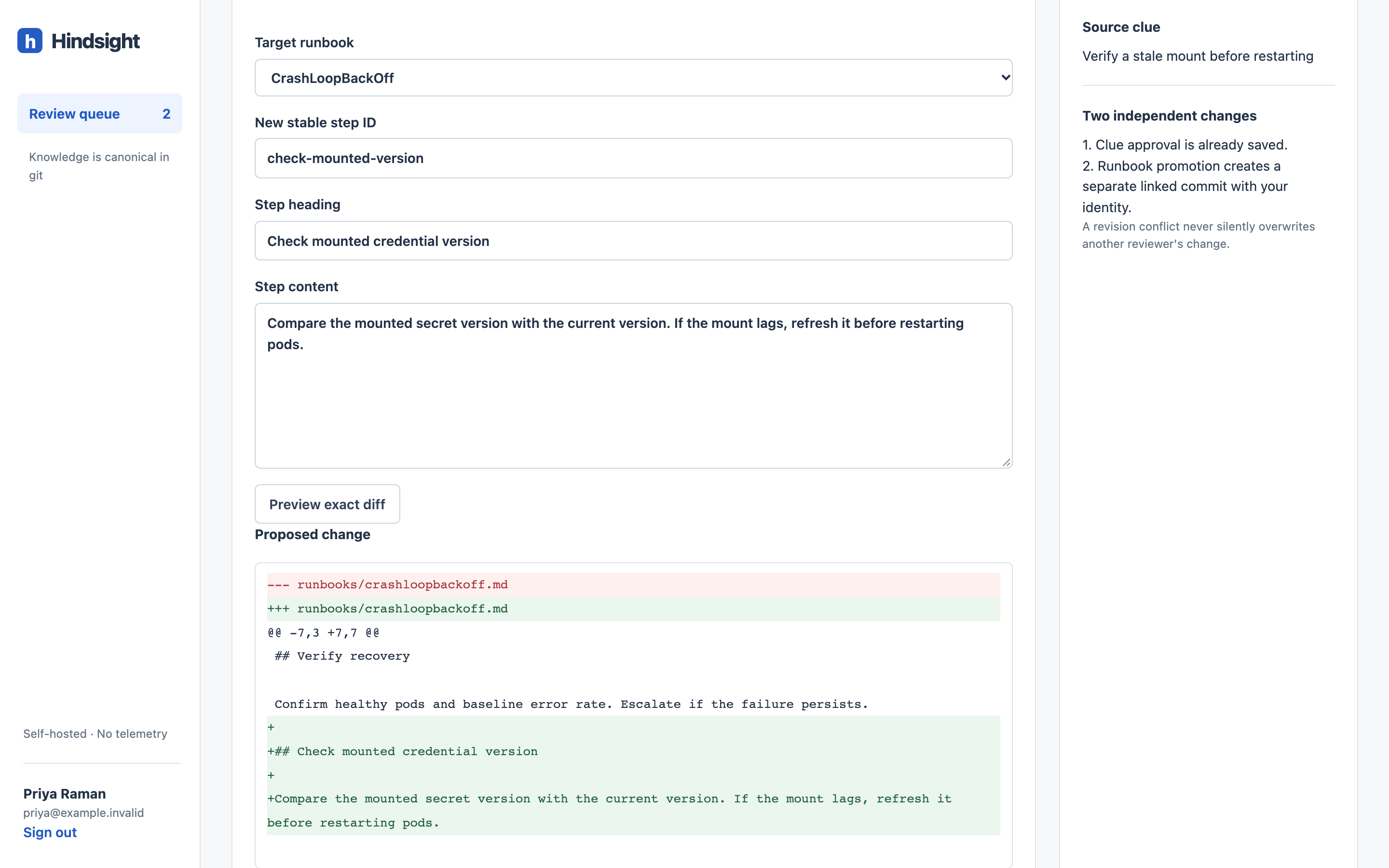
Teams that want full ceremony can set REVIEW_MODE=git: captures land on a proposal branch and are reviewed as normal pull requests with branch protection.
Trust states in recall
| Status | Meaning | In recall |
|---|---|---|
proposed |
Captured, not yet reviewed | Returned with an unreviewed flag; agents may use it but must say so |
approved |
A human reviewed the evidence | Ranked highest |
stale |
Approved, but no confirming outcome for N days (default 90) | Returned with a warning to re-check |
rejected |
Reviewed and declined | Excluded, kept for audit and duplicate suppression |
report_outcome lets an agent record "ran runbook X, step check-mounted-version fixed it". A reported success can renew a clue's confirmation, but it never approves a proposed clue on its own.
Storage, search and auth
- Git is the only store. The server keeps a local clone, commits on every write and pushes on a timer. There is no GitHub API dependency, and local commits stay usable during an upstream outage.
- Search is SQLite FTS5, rebuilt from the clone on start and after each pull. Optional embeddings add semantic ranking.
- Auth uses per-user API keys issued by the server, so every commit carries a real author. Keys map to team scopes, and scopes are filtered before results, counts and snippets.
- MCP is served over Streamable HTTP at
/mcp, plus stdio for local use and a stdio-to-HTTP proxy for clients that only speak stdio.
What it never does
Hindsight does not run an agent, execute commands against production, host your data, offer RBAC beyond team scoping, or send telemetry.